

B2B Lead Generation: The Complete Guide to Qualified Leads
Most B2B lead generation guides list the same eight channels, repeat the same funnel diagram, and call it a strategy. Almost none of them tell you which channels actually justify the effort for your deal size, how to tell a real lead from a name on a spreadsheet, or how to build a program that keeps working after the tactic of the month stops working.
This guide is built to answer those questions directly, and to stay useful as the specific tactics around it change. Where something is likely to shift year to year, such as which channels are producing the strongest response rates right now, that’s called out clearly so you know what to treat as durable and what to revisit.
What B2B Lead Generation Actually Means
B2B lead generation is the process of identifying potential business buyers, attracting their interest, and turning that interest into an identifiable opportunity for a sales conversation.
That sounds simple. In practice, B2B buying is not a single-person decision. A typical purchase involves multiple stakeholders, a longer evaluation window, more internal debate, and more research before anyone talks to a salesperson. That changes what “a good lead” actually
looks like.
Someone downloading a checklist is not automatically a sales opportunity. A decision-maker at a company that matches your ideal customer profile, who is actively researching a problem you solve, and who has real budget authority or influence, is a different category of lead entirely, even if both actions look identical in your CRM.
A useful lead generation program answers four questions before it sends a single email or runs a single ad:
- Who should we target?
- Why should we target them, specifically, right now?
- What evidence do we have that they’re interested?
- What should happen after they respond?
When those four questions are answered consistently, lead generation stops being a contact-collection exercise and starts functioning as a pipeline system.
B2B Lead Generation vs. Demand Generation
These terms get used interchangeably, and that’s a mistake, because they solve
different problems.
Demand generation builds awareness and interest around a problem or category, often before anyone is ready to be captured as a lead. It’s the LinkedIn post someone half reads, the podcast episode that plants an idea, the blog post that shows up during early research.
Lead generation captures that interest once it has formed. It’s the demo request, the pricing page visit, the report download that comes with a name and a work email attached.
A buyer’s actual path usually looks something like this: they see your brand mentioned somewhere, read a piece of educational content weeks later, come back through search when the problem becomes urgent, and only then fill out a form or ask for a meeting. Demand generation created the interest along the way. Lead generation is what turned that interest into a record your sales team can act on.
The strongest B2B programs don’t pick one over the other. They build both, and they connect them, so demand generation content is actually feeding the top of the lead generation funnel instead of existing in isolation.
If you’re building both motions together rather than treating them separately, this is exactly where Mandit’s demand generation programs are designed to plug in.”

Qualified vs. Unqualified Leads: Why the Distinction Decides Your ROI
Picture two people downloading the exact same industry report.
Person A is a marketing student working on a class project. No budget, no company, no buying timeline.
Person B is a VP of Marketing at a company matching your ideal customer profile, currently evaluating vendors in your category, with real influence over the purchase.
Both show up as “a lead” in most systems. Only one is worth your sales team’s time, and treating them the same is where most lead generation budgets quietly leak.
A qualified B2B lead generally clears four bars:
Fit. Does the person and the company match your ideal customer profile: industry, company size, revenue band, geography, tech stack, business model, job function?
Intent. Is there real evidence they’re evaluating a solution to a problem you solve? Pricing page visits, demo requests, competitor comparisons, relevant webinar attendance, and specific research behavior all count. A single blog visit does not carry the same weight as a demo request, and treating them the same inflates your lead count while diluting its meaning.
Authority. Can this person influence the decision? They don’t need final sign-off. A strong internal champion who can open doors to the actual decision-maker is genuinely valuable.
Data quality. Can your sales team actually find and reach this person? A wrong job title, a stale email, or a duplicate record can quietly kill an otherwise strong lead before anyone gets the chance to follow up.
The goal was never to maximize the number of leads generated. It’s to maximize the number of leads that could realistically become revenue, given the budget and sales capacity you actually have. A campaign that produces fifty genuinely qualified leads will consistently outperform one that produces five hundred unqualified ones, on essentially every metric that matters to the business, including pipeline generated per dollar spent.
The 8 B2B Lead Generation Channels, and How to Choose Between Them
There’s no universal best channel. The right mix depends on your average deal size, sales cycle length, the size of the buying committee you’re selling into, and how quickly you need pipeline versus how much you can invest in something that compounds over time.
Outbound email. Still effective when the targeting is sharp and the message is specific. The failure mode is treating it as a volume game: the same message sent to fifty thousand contacts almost always underperforms a smaller, well-segmented send built around a real trigger, such as a funding round, a leadership change, or a specific technology in their stack. The better question isn’t how many emails you can send. It’s which accounts actually have a reason to hear from
you today.
LinkedIn. Valuable because it puts you directly in front of professional audiences and decision-makers, but connection requests sent at scale without context rarely convert. What tends to work better is a sequence: research the account, engage with something relevant they’ve posted or commented on, then reach out with something specific to say, rather than opening cold.
SEO and content marketing. The slowest channel to show results, often three to six months before meaningful organic traffic, but it compounds in a way paid channels don’t, and it tends to produce some of the highest-intent leads available, since the person is actively searching for a solution to a problem they already know they have. For a new domain specifically, individual articles need to work together as a topic cluster rather than exist as disconnected posts, which is part of why this guide is structured to support future, more specific articles linking back to it.
Paid search and paid social. Faster to produce visibility than organic search, and useful for well-defined, high-intent audiences, but it stops the moment spend stops, and it’s expensive on competitive B2B terms. A campaign targeting a specific comparison or pricing query has very different commercial intent than one targeting a broad educational term, and the landing page and conversion path should reflect that difference.
Content syndication. Distributing existing assets through partner and publisher networks to reach audiences beyond your own traffic. Particularly useful while a domain is still building organic visibility, or when you have a genuinely strong asset and want reach into specific industries you don’t already have a presence in. A structured approach, often called waterfall content syndication, prioritizes higher quality publisher placements first and cascades down through secondary sources only once those are exhausted, which tends to produce meaningfully better lead quality than a single flat distribution list. The metric that matters isn’t how many contacts a syndication campaign produces. It’s how many matched your ideal customer profile and how many sales actually accepted.
Webinars and events. Strong for complex products where a prospect benefits from learning something before a sales conversation. A specific, narrow topic filters for the right audience far better than a broad one. “How Enterprise Revenue Teams Can Cut Lead Response Time Without Adding Headcount” will attract a more relevant registrant list than “The Future of Marketing,” even though the second title sounds bigger.
Referrals and partnerships. Often the highest-converting source available, because trust is inherited from whoever made the introduction. The limitation is scale: a referral program is only as strong as the customer or partner base feeding it, which makes it a channel that grows more valuable over time rather than one you can turn on immediately.
Account-based marketing. The right approach when your strategy centers on a defined list of high-value accounts rather than a broad market. Instead of asking how many leads a campaign can generate, ABM asks how effectively you can engage the specific accounts that would move the business if they closed. This tends to make the most sense for enterprise deals with a small number of target accounts and a longer, more considered buying process.
Most effective programs don’t run all eight at once. They typically pair one always-on channel that compounds, like SEO or content, with one controllable-volume channel, like outbound email or paid search, that can be scaled up or down as pipeline needs shift.
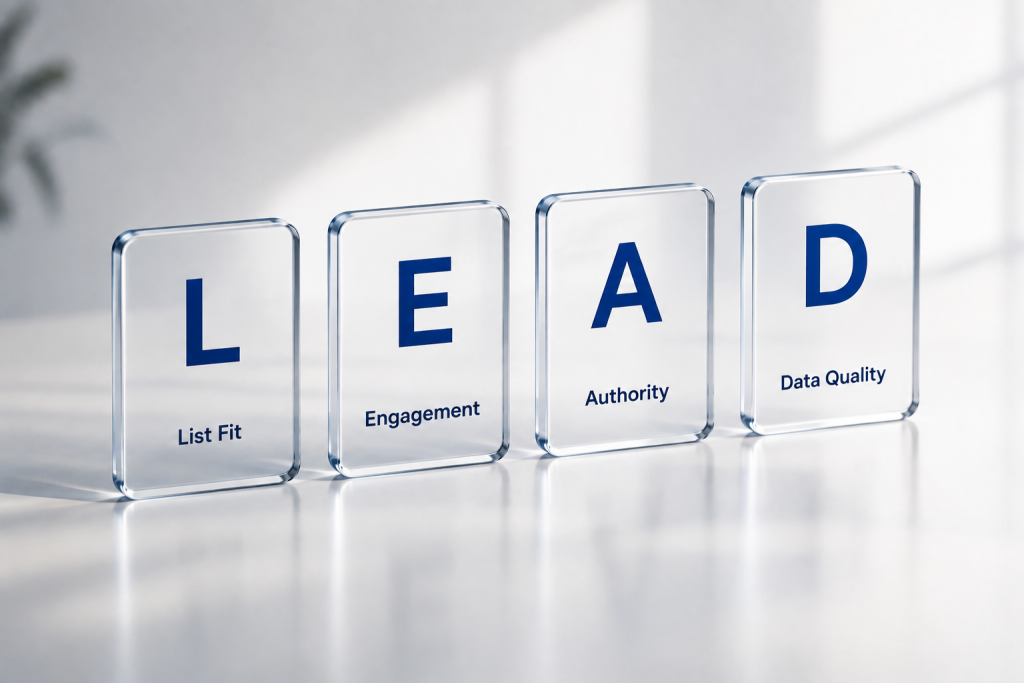
The LEAD Framework for B2B Lead Qualification
BANT and MEDDIC are useful once a lead has already reached a rep, but they’re heavier than most teams need for a first-pass filter. The LEAD framework is meant for that earlier stage, before a lead ever reaches sales.
L – List Fit. Does the account and contact match your ideal customer profile on industry, company size, geography, job function, and technology environment?
E – Engagement. Has the prospect shown meaningful interest, such as a demo request, a pricing page visit, or genuine engagement with relevant content? Not every interaction carries equal weight. A pricing page visit signals something different than a passive social interaction, and your scoring should reflect that difference rather than treating all activity as equivalent.
A – Authority. Can this contact influence the buying decision, either directly or by connecting you to someone who can?
D – Data Quality. Is the contact and company information accurate enough for your team to actually act on: current job title, working email, correct company, no duplicate record?
A practical rule that works for most teams: a lead should clear at least three of these four criteria before it’s routed to sales. That single filter typically removes a large share of raw form fills and list contacts before they ever reach a rep, which is the point. It protects your team’s time and keeps your qualified lead to opportunity conversion rate honest instead of diluted.
How to Build a B2B Lead Generation Funnel
Step 1: Define your ideal customer profile with real specificity. “Mid-market SaaS companies” isn’t specific enough to build a campaign around. Define the actual characteristics that make an account valuable: industry, employee range, revenue band, relevant departments, and the kinds of triggers that suggest timing is right, such as new funding, new leadership, or active hiring in a relevant function. You should be able to name real companies that fit the profile, not just describe a category.
Step 2: Map the buying committee. Most B2B purchases involve more than one person: an economic buyer, a business champion, a technical evaluator, an end user, and often procurement. Your messaging and content should account for the fact that these people care about different things, even when they’re evaluating the same purchase.
Step 3: Choose two or three channels, not six. Spreading effort thin across every channel available tends to produce mediocre results everywhere rather than strong results anywhere. Pick the channels most aligned with how your specific audience actually buys, and go deeper on fewer of them.
Step 4: Build messaging around the actual problem, not a category. Avoid statements like “we help companies drive growth with innovative solutions,” which could describe almost any company in any category. Name the specific problem, why it matters, and what changes when it’s solved. Specificity is what makes a message easy to evaluate quickly, which matters more than ever now that buyers are filtering messages faster than they used to.
Step 5: Qualify before routing to sales. Apply a framework like LEAD before a lead reaches a rep, not after.
Step 6: Nurture what isn’t ready yet. Most leads that clear your qualification bar still aren’t ready to talk to sales today. They might be comparing vendors, building internal consensus, or waiting on budget. Treating these as failures instead of leads on a longer timeline wastes work you’ve already done to earn their attention.
Step 7: Measure the full funnel, not just the top of it. Track the progression from lead to qualified lead to sales accepted lead to opportunity to closed customer. This is the step most programs skip, and it’s the one that actually connects lead generation to revenue.

Metrics and Benchmarks, Without the False Certainty
Lead volume is the easiest number to report and the least useful one on its own. A more complete measurement framework tracks:
- Lead volume, how many leads a campaign produced
- Qualification rate, what share met your qualification criteria
- Sales acceptance rate, how many were accepted by the sales team
- Meeting rate, how many resulted in a real conversation
- Opportunity conversion, how many became genuine sales opportunities
- Cost per qualified lead, not cost per raw lead
- Cost per opportunity
- Pipeline generated
- Revenue influenced or sourced
A fifty dollar lead that never reaches a real conversation is more expensive, in every way that matters, than a three hundred dollar lead that becomes an opportunity. Cost per raw lead is one of the most misleading numbers a marketing team can report, because it looks efficient right up until someone checks how many of those leads actually turned into pipeline.
On benchmarks specifically: be skeptical of any guide, including this one, that hands you a single number and calls it “average.” A reasonable conversion rate depends heavily on your industry, average contract value, sales cycle length, audience, and how tightly you’ve defined qualification. An enterprise company selling a six figure contract should not evaluate its program against the same numbers as a company selling a five hundred dollar monthly subscription. Rather than asking “is our conversion rate good,” a more useful question is “is our conversion rate healthy enough to hit our revenue target with the volume we’re realistically able to generate.” That framing will tell you something actionable. A generic industry average
usually won’t.
B2B Lead Generation Compliance in the United States
Any program targeting US businesses needs to account for a handful of legal requirements that are easy to overlook until they cause a real problem.
CAN-SPAM Act. Applies to commercial email, including B2B email, not just consumer marketing. Requires accurate sender information, a subject line that isn’t deceptive, a valid physical postal address, a working opt-out mechanism, and honoring opt-out requests within the required timeframe. Full requirements are published by the Federal Trade Commission.
TCPA. The Telephone Consumer Protection Act restricts unsolicited calls and texts, which matters directly for cold calling and SMS-based outbound programs.
State-level privacy laws. California’s CCPA and similar laws in other states increasingly apply to any program collecting and storing contact data, even in a B2B context, and the specifics vary by state.
This section is informational, not legal advice. Before scaling any outbound program, have legal or compliance counsel review exactly how your organization collects, stores, and uses
contact information.
The Minimum Viable B2B Lead Generation Tech Stack
You don’t need dozens of tools to run an effective program. At a basic level, most teams need:
A CRM, to manage contacts, accounts, opportunities, and attribution in one place instead of scattered spreadsheets.
B2B contact and company data, to identify relevant accounts and decision-makers and keep records accurate enough to act on.
An outreach platform, to manage email and other outbound workflows where that’s part of your channel mix.
Analytics, to understand which channels and campaigns are actually contributing to qualified pipeline, not just raw lead count.
Marketing automation, useful once you need nurturing, segmentation, and multi-step journeys rather than one-off sends.
Intent and account intelligence, a more advanced layer that can help prioritize accounts based on real buying signals once the fundamentals above are already working.
The underlying principle: add a tool to solve a specific operational problem you actually have, not because a competitor uses it or because it exists. A complicated stack cannot compensate for a poorly defined ideal customer profile or weak messaging, and teams frequently buy tools to solve problems that were never a tooling problem in the first place.
Common B2B Lead Generation Mistakes
Optimizing for lead volume. More leads don’t automatically mean more revenue. If sales can’t work through them, or most don’t match your ideal customer profile, more volume just creates more operational drag.
Targeting everyone. A broad audience produces broad messaging, and broad messaging rarely resonates with anyone specifically. A tightly defined ideal customer profile makes it easier to write something that actually lands.
Ignoring buying intent. Not every account is equally ready to engage. Intent signals exist specifically to help you prioritize where timing and relevance are strongest right now, and ignoring them means spending equal effort on accounts that are and aren’t ready.
Routing every lead straight to sales. Sales time is expensive and finite. Qualification exists to protect that time for the leads with genuine potential.
Generic messaging. A message written for everyone tends to resonate with no one. The strongest campaigns speak directly to a specific role, problem, and context.
Measuring leads instead of pipeline. Lead counts are an activity metric. Pipeline and revenue are business outcomes. Reporting the first without the second is easy to do and easy to be misled by.
Relying on a single channel. An algorithm change, a deliverability issue, a spike in ad costs, or a declining response rate can affect any one channel quickly. A program built on two or three channels is more resilient than one built on a single point of failure.
How to Diagnose Weak Lead Quality
If your sales team keeps saying the leads aren’t good, resist the instinct to simply generate more of them. Work backward through the funnel instead.
Check your ideal customer profile. Are you actually targeting the right companies, or a category that’s close but not precise?
Check your personas. Are you reaching people with real influence over the purchase, or people who are simply easy to find?
Check your data. Are contact and company records accurate, or is stale data quietly undermining an otherwise sound campaign?
Check your offer. Does the content attract genuine buyers, or people who are only interested in free information with no intent to purchase?
Check your qualification criteria. What specifically makes a lead sales-ready in your business, and is that definition actually being applied consistently?
Check the feedback loop. Is sales feeding conversion data back to marketing, so the definition of “a good lead” is grounded in what actually becomes a customer rather than decided
in isolation?
That last point is the one most programs skip, and it’s usually where the real answer is hiding. Marketing shouldn’t define lead quality without input from what sales actually closes.
What's Changed Recently, and What Hasn't
The fundamentals in this guide, fit, intent, authority, and data quality as the basis for qualification, are not going to change. What does shift more often is the specific competitive environment around lead generation. As of now, three things are worth knowing:
Inboxes are more automated on both sides. Buyers increasingly use AI to filter and summarize what lands in their inbox, and sellers use AI to write and send more of it. That combination means generic, high-volume outreach gets filtered out faster than it used to, and the advantage has shifted toward smaller, more relevant sends over broad ones.
Buyers self-educate earlier and more thoroughly. Most B2B buyers have already researched a category and shortlisted options before a sales rep ever speaks with them. That means lead generation increasingly has to work during that earlier research phase, through content and search, rather than relying entirely on outreach to create the first spark of interest.
Intent signals carry more weight relative to contact volume. A list of ten thousand contacts with no signal of active buying behavior is worth less than a much smaller list showing real engagement, like pricing page visits or competitor research. Programs that prioritize based on signal consistently outperform those built purely around broad, unsegmented reach.
This section will be the part of the guide most worth revisiting periodically. The rest of the framework above it is built to hold up regardless of which specific tactic is working best in a given year.
Frequently Asked Questions
What is B2B lead generation?
What's the difference between B2B lead generation and demand generation?
What makes a B2B lead qualified?
How do B2B companies generate leads?
How long does B2B lead generation take to produce results?
How many leads does a company actually need?
Is lead volume or lead quality more important?
every business.
Should B2B lead generation be outsourced?
ON THIS PAGE
- What B2B lead generation actually means
- Lead generation vs. demand generation
- What makes a lead qualified, not just captured
- The 8 B2B lead generation channels, and how to choose between them
- The LEAD framework for fast, consistent qualification
- Building a repeatable lead generation funnel
- Metrics and benchmarks, without the false Certainty
- Compliance for US B2B programs
- The minimum viable tech stack
- Common mistakes that quietly kill lead gen programs
- How to diagnose weak lead quality
- What’s changed recently, and what hasn’t
- FAQ
Ready to Build a More Predictable B2B Pipeline?
Mandit Global helps B2B organizations identify target accounts, engage the right decision-makers, and build qualified pipeline through lead generation and demand generation programs designed around your actual ideal customer profile, not a generic playbook.

SALES OFFICE
- American General Center 2929 Allen Parkway, Suite 200, Houston, Texas – 77019, USA.
- +1 254 277 8874
DELIVERY CENTER
- C Core, 4th Floor, Office No. 4030 Solitaire Business Hub, Sr. No. 207 Viman Nagar, Clover Park Opposite NECO Garden Society Pune, Maharashtra 411014
- contact@manditglobal.com