
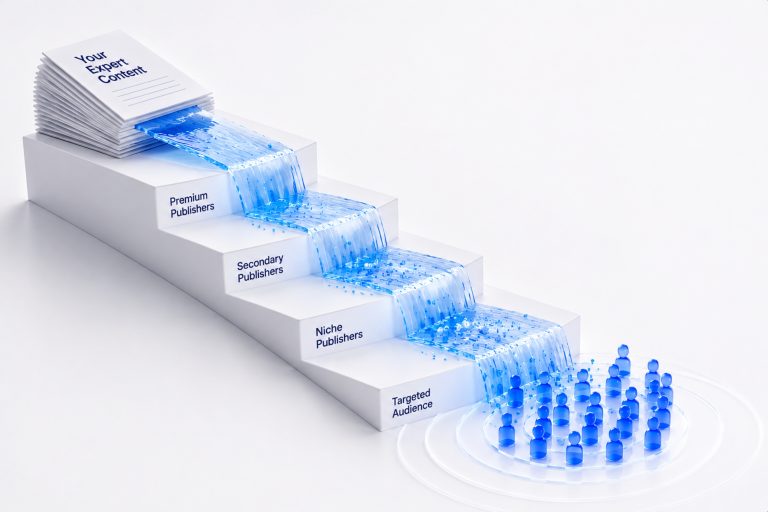
Waterfall Content Syndication: A Smarter Way to Generate B2B Leads
Content syndication gives B2B companies a way to reach potential buyers beyond their own website, search results, and social media channels. By distributing valuable content such as whitepapers, research reports, ebooks, and webinars through relevant external channels, businesses can introduce their brand to audiences they may not otherwise reach. But getting someone to download an asset is only the first step.
A prospect may download a report because they are researching a business problem. They may be comparing different solutions or simply looking for information. Another prospect may download the same report and continue engaging with related content over the following weeks. Both contacts may appear as new leads in your CRM, but their level of interest can be very different.
This is where Waterfall Content Syndication takes a more focused approach.
Instead of treating the first content conversion as the end goal, it looks at what happens after that initial interaction. Continued engagement, account activity, lead qualification, and nurturing can provide a clearer picture of which prospects are worth further attention.The goal is not simply to generate more leads.
The goal is to understand which leads have the potential to become qualified B2B opportunities.
What Is Waterfall Content Syndication?
Waterfall Content Syndication is an approach to B2B content syndication that looks beyond the first content interaction and evaluates how prospects engage over time.
Traditional content syndication helps businesses distribute content such as whitepapers, research reports, ebooks, and webinars to a targeted audience through external publishers and channels. When someone engages with that content, their information can be captured and added to the company’s marketing database. That first interaction is valuable.But a content download alone does not tell you whether the prospect is interested in your solution, fits your ideal customer profile, or is ready to enter a sales conversation.
Waterfall Content Syndication looks at the engagement that follows. Does the prospect engage with another relevant resource? Do they continue researching the same topic? Are other people from the same company showing similar interest? Does their activity become stronger over time?
These additional signals can help marketers understand the difference between a simple content download and a prospect showing meaningful interest. A simple way to think about it is:
The first download creates a lead. Continued engagement helps you understand the lead.
This matters because B2B buyers rarely make a decision after consuming one piece of content. They research problems, compare solutions, involve other stakeholders, and often spend weeks or months evaluating their options. Waterfall Content Syndication helps marketers look at this broader journey instead of judging a prospect based on a single action.
How Waterfall Content Syndication Works for B2B Lead Generation
The process starts by defining the audience you want to reach. Before launching a campaign, marketers identify the companies, industries, job roles, and markets that best match their ideal customer profile. This helps ensure that content is distributed to people who are more likely to have a relevant business need.
The next step is to offer content that provides genuine value to that audience. A prospect may download a research report, access an industry guide, or register for a webinar. This creates the first engagement and gives marketing a reason to continue the conversation.
But the process does not stop at the form submission. Marketers can monitor what happens next. If the prospect engages with another relevant resource, that interaction provides additional context. If they continue returning to related content, the pattern becomes more meaningful. The same principle can be applied at the account level.
For example, one person from a target company may download an ebook, while another employee from the same company later engages with a related report. Looking at these activities together can provide a broader view of the account’s interest.
From there, marketers can determine the most appropriate next step. Some prospects may need additional education. Others may be suitable for continued nurture. Prospects showing stronger engagement and a good company fit may deserve closer attention from sales.
Waterfall Content Syndication can be part of a broader B2B lead generation strategy, helping businesses attract, qualify, and nurture potential buyers throughout the buying journey.
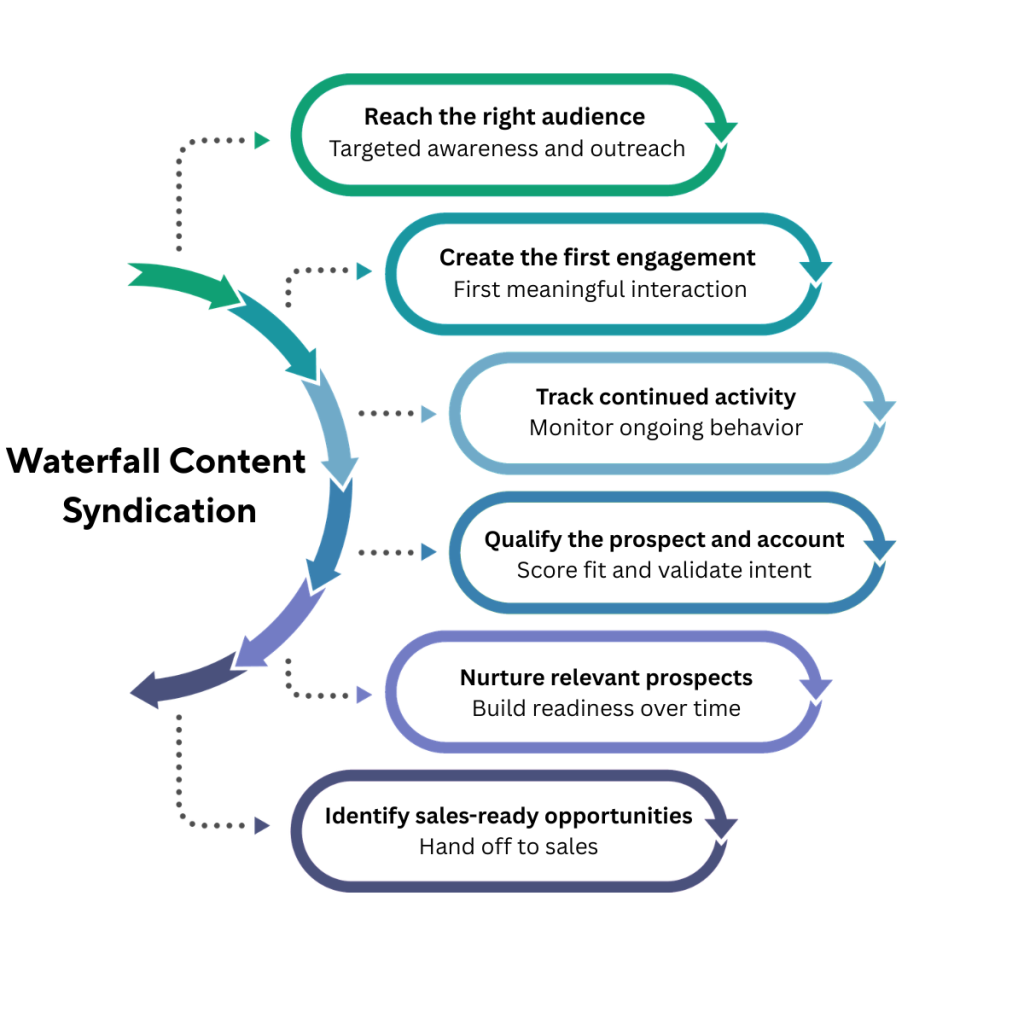
The process can be summarized as:
Reach the right audience → create the first engagement → track continued activity → qualify the prospect and account → nurture relevant prospects → identify sales ready opportunities
The important point is that the first conversion is the beginning of the process, not the end of it.
A Practical Example of Waterfall Content Syndication
Consider a B2B software company that wants to reach IT decision makers at mid sized companies. The company distributes a research report through a content syndication campaign. A prospect from a target company downloads the report. That first interaction creates a new lead, but the company does not immediately send the contact to sales. Instead, the engagement develops through several stages:
Download → Second Engagement → Account Activity → Qualification → Nurture → Sales
- Download: The prospect downloads a research report about a business problem relevant to the company’s solution. At this point, the prospect has shown interest, but there is not enough information to determine whether they are a strong opportunity.
- Second Engagement: A few days later, the same prospect engages with a related guide or webinar. This additional interaction suggests that their interest may be more than a one time content download.
- Account Activity: Another employee from the same company downloads a related resource. Now marketing can see activity from multiple people within the same account, providing a stronger signal of potential account interest.
- Qualification: The company evaluates the account based on factors such as company fit, job role, content engagement, and account activity. The account appears to match the ideal customer profile and has shown meaningful engagement.
- Nurture: The prospect is not necessarily ready to speak with sales yet, so marketing continues the conversation with relevant content based on the topics they have shown interest in.
- Sales: As engagement becomes stronger and the account meets the qualification criteria, the opportunity can be passed to sales for a more focused conversation.
The important point is that the original download did not make the lead sales ready. The sequence of interactions provided the additional context needed to understand its potential.
This is what makes the Waterfall approach different from treating every content download as an immediate sales opportunity.
Why Waterfall Content Syndication Matters for B2B Companies
Lead generation is important, but the number of leads generated does not tell the entire story. A campaign can produce hundreds of downloads while generating very few qualified opportunities. Some contacts may not match your target market. Others may download an asset once and never engage again.
At the same time, some prospects may continue engaging with content related to a problem your company solves. These leads should not necessarily be treated in the same way. Waterfall Content Syndication gives marketers a way to look beyond the initial conversion and understand the engagement that follows.
Instead of asking only:
“How many leads did we generate?”
marketers can also ask:
“Which leads are continuing to engage, and which accounts are showing meaningful interest?”
This shift can make content syndication more useful for B2B demand generation.
It also supports more relevant nurturing. If a prospect repeatedly engages with content about a specific business challenge, future communication can reflect that interest instead of sending generic messages.
This becomes especially important when the B2B sales cycle is long.
A prospect may not be ready to speak with sales when they first download your content. That does not mean the lead has no value. Continued engagement may provide more information about their interests, company, and potential buying stage.
The goal is not simply to generate more leads. It is to get more value from the leads you generate.
When Waterfall Content Syndication Makes Sense
Waterfall Content Syndication can be useful when a business needs more than a one time lead capture strategy and wants to understand how prospects engage after the first interaction.
It can be especially useful in situations such as:
- Long B2B sales cycles: When buyers need time to research, compare solutions, and involve multiple decision makers before making a purchase.
- High lead volume but low lead quality: When campaigns generate plenty of contacts but only a small percentage appear relevant or sales ready.
- Complex or high value solutions: When a single content download does not provide enough information to determine whether a prospect is a meaningful opportunity.
- Multiple stakeholders within target accounts: When buying decisions involve several people and engagement from more than one contact can provide a clearer picture of account interest.
- Content led demand generation: When a company already produces valuable content and wants to understand which prospects continue engaging with it rather than measuring success only by downloads.
The common factor is simple: the first conversion is not enough information to determine the value of a prospect. When continued engagement, account activity, and qualification matter, a Waterfall approach can give marketing and sales teams a more complete view of where potential demand is developing.
Fundamental Components of a Waterfall Campaign
A Waterfall Campaign works by looking at how prospects engage over time and using those interactions to determine what should happen next.
Instead of treating every lead the same way, the campaign uses different stages to understand engagement, qualify prospects, and guide them toward the next appropriate step.
- Staged Lead Qualification
Not every content download represents the same level of interest. A Waterfall Campaign evaluates leads in stages, considering factors such as company fit, job role, content engagement, and continued activity. As prospects show stronger and more relevant engagement, they can move to the next stage of qualification.
- Relevant Content and Messaging
The content a prospect receives should reflect their interests and stage in the buying journey. Someone who is still researching a problem may benefit from educational content, while a prospect showing stronger interest may be ready for specific solutions, use cases, or product information. This keeps communication useful rather than sending the same message to every lead.
- Strategic Follow-Up and Nurturing
Follow-up should be based on what the prospect does, not simply on the fact that they submitted a form. Prospects who need more time can continue receiving relevant content, while those showing stronger engagement can receive more focused communication. This allows marketers to maintain interest without pushing prospects toward sales too early.
- Account-Level Engagement
A Waterfall Campaign can look beyond individual contacts to understand activity across an account. For example, if several people from the same company engage with related content, that activity may provide a stronger signal than a single download. Looking at account-level engagement gives marketing teams additional context when deciding which companies deserve further attention.
- Data-Driven Campaign Optimization
Each stage of the campaign generates data that can be used to improve future activity. Marketers can analyze which content generates engagement, where prospects drop off, which audiences respond best, and which activities contribute to qualified opportunities. These insights can then be used to improve targeting, content, nurturing, and follow-up. Together, these components create a process that moves beyond simply capturing leads.
A Waterfall Campaign helps marketers understand what happens after the first interaction and use that information to guide prospects toward the next meaningful step.
How Waterfall Content Syndication Differs From Traditional Content Syndication
Traditional content syndication and Waterfall Content Syndication both help B2B companies reach new audiences and generate leads through valuable content. The key difference is what happens after the initial content interaction.
Traditional content syndication often focuses on distributing content to a targeted audience and capturing the information of people who engage with it.
Waterfall Content Syndication takes the process further by looking at continued engagement, account activity, qualification, and nurturing to identify prospects with stronger potential.
First Conversion vs. Continued Engagement
Traditional content syndication often treats a content download as the primary conversion point.
Waterfall Content Syndication looks at what happens after that download. Additional content interactions can provide more information about the prospect’s level of interest and buying journey.
Lead Volume vs. Lead Quality
Traditional content syndication may focus heavily on the number of leads generated from a campaign.
Waterfall Content Syndication looks beyond lead volume by considering company fit, role, continued engagement, and other signals that can help determine lead quality.
Individual Contact vs. Account Activity
Traditional content syndication commonly evaluates engagement at the individual contact level.
Waterfall Content Syndication can also look at activity across an account. If multiple people from the same company engage with related content, that activity can provide a stronger picture of potential account interest.
Standard Follow Up vs. Relevant Nurturing
Traditional campaigns may place new leads into a standard follow up or nurture process.
Waterfall Content Syndication uses engagement information to make the next step more relevant. A prospect who is still researching may need educational content, while a prospect showing stronger engagement may be ready for more focused communication.
Lead Generation vs. Pipeline Development
Traditional content syndication is primarily focused on reaching new audiences and generating leads.
Waterfall Content Syndication connects the initial content interaction with continued engagement, qualification, nurturing, and sales follow up to help identify opportunities that can contribute to pipeline.
The Difference in Practice
Imagine two prospects download the same whitepaper. With a traditional approach, both contacts may enter the same follow up process after the download. With a Waterfall approach, their journeys can develop differently.
Prospect A downloads the whitepaper but does not engage with any other content.
Prospect B downloads the whitepaper, attends a related webinar, engages with another resource, and has another employee from the same company interact with related content.
Both prospects started with the same action, but the engagement that followed tells a very different story.That additional information can help marketers determine which prospect and account deserve more attention.
Traditional content syndication creates the initial opportunity. Waterfall Content Syndication helps determine what that opportunity becomes.
The difference is not that traditional content syndication is ineffective.
The difference is what happens after the first content interaction.
How Waterfall Content Syndication Improves B2B Lead Quality
A content download does not automatically make someone a qualified lead. Lead quality depends on several factors, including whether the company fits your target market, whether the person has a relevant role, whether their interests align with your offering, and whether they continue engaging with your content.Waterfall Content Syndication gives marketers more information to evaluate these factors.
For example, a prospect from a target company who continues engaging with relevant content may deserve more attention than someone who downloaded one asset and never returned.
Account activity can provide additional context. If several people from the same company engage with content around a similar business problem, the account may be worth looking at more closely. This does not necessarily mean the account is ready to buy. It simply means marketing has more information to work with.
That information can help teams decide whether a prospect should remain in nurture, receive more relevant content, or move toward sales qualification. A useful way to think about lead quality is:
Company fit + role + engagement + account activity + buying stage
No single factor should determine whether a lead is valuable. The stronger picture comes from looking at the signals together.
Better information helps marketing teams make better decisions about where to spend their time.
How to Measure Waterfall Content Syndication
Lead volume is an important starting point, but it should not be the final measure of campaign success. A campaign can generate hundreds of content downloads without creating meaningful business opportunities. That is why Waterfall Content Syndication should be measured across the buyer journey, from the first interaction through qualification and pipeline.
Start with basic campaign metrics such as:
- Content downloads
- Leads generated
- Cost per lead
- Engagement rate
These metrics tell you how much activity the campaign generated. Then look at stronger engagement and qualification signals:
- Continued engagement
- Account engagement
- Qualified leads
- Sales accepted leads
- Opportunities created
Finally, measure the outcomes that connect the campaign to business results:
- Pipeline generated
- Revenue contribution
The right metrics depend on your campaign goals and sales cycle. An awareness campaign may focus more on reach and engagement, while a B2B demand generation campaign should place greater emphasis on qualified opportunities, pipeline, and revenue. The key is not to treat every content download as a successful outcome.
Downloads measure activity. Qualified opportunities show potential. Pipeline shows business impact.
The ultimate goal of Waterfall Content Syndication is therefore not simply to generate more downloads or contacts. It is to identify which engagement can progress into qualified opportunities and measurable pipeline.
Turning Content Syndication Into B2B Pipeline
The real value of Waterfall Content Syndication is not simply generating more content downloads. It is creating a clearer path from the first interaction to a potential business opportunity.
A prospect may begin by downloading a report. Continued engagement can reveal what topics matter to them. Account activity can provide additional context. Qualification can help determine whether the prospect and company are a good fit. Nurturing can then keep the conversation relevant until the prospect is ready for a deeper sales conversation. This creates a connected path:
Content → Engagement → Qualification → Nurture → Sales → Pipeline
Each stage has a purpose. Content creates the initial opportunity to reach a potential buyer. Engagement provides additional insight into their interests. Qualification helps separate stronger prospects from contacts that may not be a good fit.
Nurturing keeps relevant prospects engaged until they are further along in their buying journey. Sales can then focus on accounts where there is a stronger combination of company fit, relevant interest, and meaningful engagement.
The goal is not to send every content download to sales. Doing so can overwhelm sales teams with contacts that may have little buying potential. Instead, Waterfall Content Syndication helps marketing teams build a clearer picture of where demand is developing. That makes the strategy especially valuable for B2B companies with longer sales cycles, multiple decision-makers, and complex buying journeys.
The goal is not more leads for the sake of more leads. The goal is to turn content engagement into better-qualified conversations and, ultimately, stronger pipeline.
When content syndication is connected to qualification, nurturing, and sales follow-up, it becomes more than a lead generation tactic.
It becomes a structured approach to identifying where genuine B2B demand is developing and giving those opportunities the attention they deserve.
Frequently Asked Questions
What is Waterfall Content Syndication?
How is Waterfall Content Syndication different from traditional content syndication?
Does Waterfall Content Syndication replace traditional lead generation?
What types of content can be used in Waterfall Content Syndication?
How does Waterfall Content Syndication improve lead quality?
Can Waterfall Content Syndication support account based marketing?
What metrics should be used to measure Waterfall Content Syndication?
Is Waterfall Content Syndication suitable for companies with long B2B sales cycles?
ON THIS PAGE
- What Is Waterfall Content Syndication?
- How Waterfall Content Syndication Works for B2B Lead Generation
- A Practical Example of Waterfall Content Syndication
- Why Waterfall Content Syndication Matters for B2B Companies
- When Waterfall Content Syndication Makes Sense
- Fundamental Components of a Waterfall Campaign
- How Waterfall Content Syndication Differs From Traditional Content Syndication
- How Waterfall Content Syndication Improves B2B Lead Quality
- How to Measure Waterfall Content Syndication
- Turning Content Syndication Into B2B Pipeline
- Frequently Asked Questions About Waterfall Content Syndication
Ready to Get More From Your Content Syndication?
Mandit Global helps B2B companies turn content syndication into a more focused demand generation process. Instead of stopping at the first download, we help businesses understand continued engagement, account activity, lead quality, and buyer readiness to identify where stronger opportunities are developing.
If your campaigns are generating leads but you are still unsure which ones are worth pursuing, we can help you build a clearer path from content engagement to qualified pipeline.

SALES OFFICE
- American General Center 2929 Allen Parkway, Suite 200, Houston, Texas – 77019, USA.
- +1 254 277 8874
DELIVERY CENTER
- C Core, 4th Floor, Office No. 4030 Solitaire Business Hub, Sr. No. 207 Viman Nagar, Clover Park Opposite NECO Garden Society Pune, Maharashtra 411014
- contact@manditglobal.com